Wednesday, December 18, 2013

The Internet Continues to Surprise Me

Even after all these years, the Internet continues to surprise and delight me.  Even with the steady stream of breaking news; mostly bad, every now and again I come across something that triggers a sense of nostalgia and overall good vibes. Usually these items come at just the opportune time; lifting my spirits or validating a moment in my life. I am sure we have all had similar experiences. I cannot be the only one who has experienced this. 

My most recent experience was just last night. I decided to check out the website of my alma mater, Adelphi University; only to find that the student run weekly newspaper was available online.  Imagine my surprise to find my very first published article on a computer screen.  You may not think this is such a big deal.  Many student newspapers are readily available to view online and have been for quite some time.  However, the article was written in 1981; before personal computers. It was typed up using a Smith Corona electric typewriter minus the more recent invention of the correction ribbon.  It then had to be manually typeset and proof read before publication.

While not ground breaking journalism by any means, I ask your indulgence as I share with you a transcription of the article.  It is my way of making sure one of my proudest moments continues on...on the Internet, of course.


Wednesday, November 4, 1981 THE DELPHIAN Page Thirteen


Do Americans Truly Understand The Cockroach?

BY PATRICIA DELAHUNTY

In years past, we have encountered such crusades as "Save the Dolphin," "Save the Whale," and "Save the Baby Seal." The basic complaint of these crusades has been the senseless slaughter of the animals. I feel it is time we organized yet another crusade. We must fight to save the cockroach.

It has been an American societal ritual to step on and murder every innocent cockroach that is seen scurrying across the floor. The slaughter of these innocent creatures does not stop there. There are many chemical sprays, foams, and other devices which are sold to murder cockroaches "where they breed."

Do Americans truly understand the plight of the cockroach? He leaves his home and seeks food to support his family. The average American goes through the same routine. How would the Manhattan businessman feel if something stomped him to death while he was rushing between office buildings? Americans need more than that to understand the cockroach's dilemma.

How about the chemical attack on cockroaches' homes? How does their home being bombarded by chemicals differ from such Instances as the Love Canal, the Suffolk County dump, or Toxic Waste Disposal? Millions of Americans are fighting for a chemical-free environment, especially in or around their homes. Is it fair to treat the cockroach's home differently from the way we treat ours?

The arguments in favor of the senseless slaughter of the cockroach Include such ideologies as "they're only bugs," "they are dirty and germ spreaders," or "the world would be healthier without them." If I may. I would like to say something about each of these misconceptions to defend the
cockroach.  

First of all, it is true cockroaches are bugs, but it is also true that they were the first bugs to Inhabit the earth. In fact, cockroaches were around way before humans. There is now a fight taking place to increase the respect given to the elderly. Shouldn't we also give respect to the cockroach who inhabited this earth longer than my 102-year-old grandmother?

Second, cockroaches are thought to be dirty and germ spreading. Cockroaches clean themselves more frequently in a twenty-four hour period than most adolescent boys. If it's okay to kill cockroaches because they are dirty, then let's kill adolescent males for the same  reason. This whole idea of being dirty is a myth. Cockroaches breed in what humans consider filthy areas. If people want to live and breed in sleazy because they want to, then why can't cockroaches be able to choose where they want to breed? Would it be fair to kill all these “motel dwellers”?  

Finally, who has the right to decide if the world would be healthier without cockroaches? Is it the research scientist at Dow Chemical that disposes of its toxic waste inefficiently? Or is it the food manufacturers who use more harmful substances than natural food in their products? With the way society is going, it seems that everything we eat, drink, do, and even say, is harmful. Instead of trying to correct any one of these harmful things, why do we pick on the poor, harmless cockroach?'

Cockroaches have acquired a very undesirable reputation over the years. This reputation must be changed. Americans are very concerned about public image and reputation. We are also concerned with the decline in the American family. We are very concerned about how other countries view our family structure and relations. According to family policy makers, the nuclear family must be preserved  If the mother or father cockroach is senselessly murdered, what becomes of the rest of the family? Sure, the  survivors will probably continue to get by, but without the comfort of the nuclear family. If an American family loses one of its members, whether it be by way death or movement away from home, many emotional and/or financial difficulties may arise. If America wants to revive the sense of the family, it should start with its cockroaches.

Cockroaches are highly discriminated against. The discrimination which they must endure is worse than the discrimination blacks, women and college students must attempt to handle. The senseless murder of cockroaches is the greatest form of discrimination we could ever create. This must stop. We must practice what we preach. We supposedly believe in the value of life, but we contradict ourselves decide if the world would be by killing cockroaches. Is death what the hard-working cockroach deserves? According to the Protestant Work Ethic which helped shape this country, if you work hard, you will receive what you deserve. The cockroach is getting the raw end of the deal.

I propose that we join together and help save this unfortunate creature from an untimely demise. It is time that we begin to any one of these harmful things, think about all creatures on this earth and not only about ourselves. If life is to continue, we must treat all life equally with no exceptions. The world is big enough for both humans and cockroaches to live together in peace.





Sunday, December 15, 2013

When Social Media Encroaches on our Everyday Lives

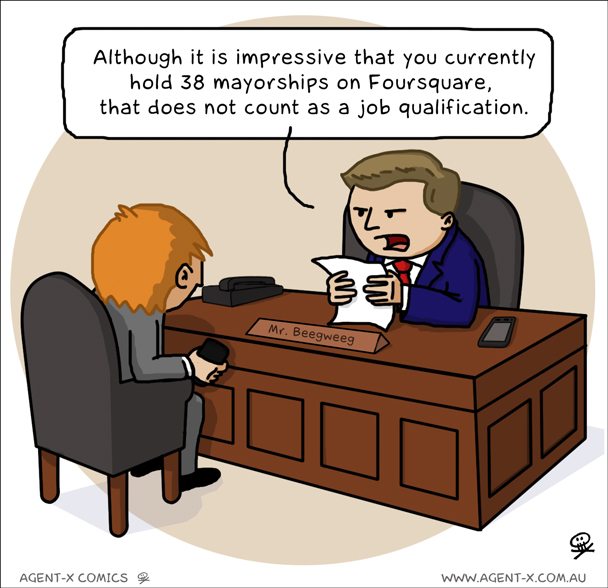
Normally my posts focus on what I encounter on various social media platforms.  However, today's article is more along the lines of how social media has made its way into our everyday lives.  In this particular case, it is the job interview process.

It began as most interviews do. The hiring manager, along with a subordinate, run through the checklist of the job description, what would be expected and then proceed to tout the wonderful things about the company which sets it apart from all the rest.  Now, comes that much anticipated question, "do you have any questions for us?"

Having done my homework; I had researched the company the best I could on the Internet. Yes, there was a website. There was even a Facebook page for its corporate office.  Honestly, I was not impressed with either.  

Since  I was not applying for a social media or marketing position; I was reluctant to initially express my actual opinion.  However, in response to their question and as a follow up to a comment made by one of the interviewers regarding the lack of consistent traffic coming into their establishment during our meeting;  I proceeded to advise them that they were missing out on an important source of potential business, both locally and nationally.

The hiring manager seemed taken aback at first.  "We have a Facebook page and a website, what more do we need?"  I proceeded to explain that having both does not constitute customer engagement and that their corporate office was letting a golden opportunity slip through their fingers both on a national and local level.  Their website was a basic, right out of box site without any of the bells and whistles visitors have grown accustomed to.  In fact, it is set up so generically that a first time visitor would be hard pressed to determine what products or services they sold.

Okay, so maybe corporate wants the website to be streamlined and just "plain".  Maybe it is part of their corporate philosophy or strategic plan.  Who am I to question?  At this point, I am only a potential customer as I have not officially been moved to the next step of the interview process.

As a potential customer and one of the millions who utilize social media in researching companies and the brands they represent, the total lack of engagement on the various social media sites is astonishing.  Their Facebook page has 76 followers and nothing has been posted by the administrators of the page since its inception.  There is one post from someone thanking them for their help 6 months prior with no response or acknowledgment.  I even dared to bring up Twitter and Pinterest backing off once their eyes started to glaze over.

A lot has been said recently about prospective employers using social media to research potential employees.  In this case, I researched a potential employer. If I had been moved to the next step in the hiring process and eventually be offered a position - would I declined based on the lack of information on the company and their obvious lack of customer engagement?  Or, would I have accepted the position knowing that I would have been able to assist them in beefing up their social media presence resulting in increased traffic?  Increased traffic would ultimately result in the potential of increased commissions for me.  Alas, that is one bridge I did not have to cross.

While I went with all intentions of selling myself as the ideal candidate for a basic sales position, I may have also taught the hiring manager a thing or two about social media and its importance to a business and its success. In a way, I left the interview feeling more confident than in previous ones.  Not because I thought I landed the position; but because I actually was able to pass on just a little bit of advice, that if taken, will enable this particular company to flourish. Granted this situation, though real, occurred over a year and a half ago and I have continued to on my journey to learn more about the world of social media.  Hopefully, this company has as well.


Wednesday, November 20, 2013

Surviving the Inevitable Friend Purge

We have all been through it in some form or another.  We have clicked that unfriend button or have had it done to us. It may have been because they offended you with something they posted; or you just weren't clicking in the virtual friendship arena.  Maybe you posted something that they took offense to. No matter what the circumstances, both of you are down 1 less friend; or, are you really?  

There are many reasons why we cultivate online friendships.  Of course, the most popular reason is that we are friends in the real world and that friendship carries over naturally to the virtual world.  More on that later; first, let's explore some of the other reasons.

  1. Mutual friends - Having mutual friends is probably the most common reason we friend someone online.  We rationalize this as, "If Jeff can be friends with Joe, then why can't I?"  Unfortunately, Jeff may be friends with Joe only because they also share a mutual online friendship with Sally.  Eventually, we find that we do not share anything in common with Joe other than Jeff, making it extremely difficult to maintain a positive and fulfilling friendship.
  2. Shared social and/or political values - Many of our online friendships are based solely on shared social and/or political values.  Are we shutting ourselves off to learning and understanding other cultures, religions and political values when we only surround ourselves with like-minded online friends?  What becomes of these "friendships" when the issue of the day is no longer relevant or conversation worthy?      
  3. Networking opportunities - There are those that collect online friends like they would business cards at a real world networking event.  They rationalize it as "You never know when the relationship will come in handy".  Nine times out of ten, these friends will sit idly by on your friends list just as their business cards will sit in a pile at the bottom of your briefcase.  Friending someone solely as a possible way to advance your career may have its place on sites such as LinkedIn; however, when it comes to Facebook, Twitter and Google Plus, which are inherently more social in nature, all it accomplishes is an increase in your friend list count.
  4. Real World Family or Friends - The ultimate reason to friend someone online is that you are actually friends (or blood related) in the real world.  It is a way to remain in contact and share the good, bad and, at times, ugly that life tends to throw our way.  There is a special connection that carries over seamlessly between the virtual and real world.  If either one decides to perform an online friend purge and you find yourself one of the purge victims; the relationship is not affected in the grand scheme of things.  

With the exception of number four, these should truly be considered connections rather than friends.  Facebook, in particular, has led us to believe that everyone of those listed on our "Friend" list are in fact friends in the true sense of the word. Can we honestly say that we maintain a close bond with everyone on that list?  Is it truly possible to have a meaningful relationship with, let's say, 1,000 people?  In reality, if we are the victims of the inevitable friend purge; are we really losing a friend?  Even in the case of a real world friend dropping you from the list; you have only lost that friend if they have dropped off your radar in the real world. Then we must ask ourselves, were they truly a friend in the first place?


Friday, November 15, 2013

Why I Love to Write

In honor of the 11th Anniversary of "I Love to Write Day", I couldn't think of a better topic to write about.  I have lost count of how many times I have been asked in recent months "why do you write a blog?".  I am usually at a loss for words when trying to answer this question.  

The written word and I have always had a personal relationship.  Not much of a public speaker, I have always been able to find my voice through the written word. It started back in high school with sappy love poems and short stories.  In college, it morphed into a full blown love affair. As a member of the school newspaper where I wrote on subjects as diverse as the lonely life of a cockroach to the opening of the new library.  In a screenwriter's class, a screenplay I wrote based on Barry Manilow's "Copacabana" was submitted by the professor to Mr. Manilow for review. (Interestingly, shortly thereafter there was a television special which utilized many of my plot points; alas, with no credit.  That is another story entirely.) Of course, there was my senior thesis on the United States' Political Influence on Post-World War II Philippines and the countless Constitutional Law Briefs; topics which would have put many to sleep.  

That was 30 years ago and much has happened over the course of that time. My dream of becoming a political journalist never took hold. Life has a way of setting its own path and you simply need follow it.

After many speed bumps and detours, I have come full circle.  What began 19 months ago as a way to fill up free time while job searching, has grown to 3 blogs, 86 published posts and over 10,000 combined views.  These numbers might not seem like milestones to the more seasoned writing veterans; but for a newbie, it is a big deal.

The fear of rejection and ridicule every time you are about to hit the "publish" button is probably something writers never get over. It is similar to an actor being afraid of forgetting their lines or a musician being booed off the stage.  While I may not have written the next great novel, I can honestly say that I am finally in a place that I feel a certain sense of fulfillment.  So, in answer to that oft asked question, I write because it is something I love to do.

Happy I Love to Write Day!

Sunday, November 10, 2013

Social Media's Role in Our Collective Conversations

Having recently attended a conference where the speakers focused primarily on women's role in politics, the biggest takeaway was the reassuring validation of a message I have been promoting for close to 2 years now - social media is an integral part of how we manage our interpersonal, business and political conversations. 

On the business and political side, when used properly, social media can be a critical enhancement. Used improperly, it can have a long lasting negative effect. From a marketing and, of course, a political standpoint, numbers (or followers) do matter. In the end, it is how the marketer analyzes those numbers and responds to them. More and more people are on the Internet via tablets, smart phones and laptops for their news and information. Less are likely to respond to print or television ads. They are more likely to share and comment on posts streaming on their Facebook, Twitter, and Google + feeds. A two way dialogue needs to be established and nurtured between the marketing or political campaigns and the potential supporter/donor or customer early on - sometimes before there is a declared candidate or an actual product/service in production. 

Our own interpersonal social media interactions are clearly more complex.  Over the years, I have had several people tell me both publicly and privately that social media is nothing but senseless fluff and of no consequence to our personal lives. On the surface, maybe it does come across as just another form of mindless entertainment. However, strip away the layers of Candy Crush posts, Bit Strip cartoon self portraits and, of course, the endless Grumpy cat images; every post we make, like or share is a reflection of who we are. The simple fact that you have clicked on the link to this post is an indication that you participate in social media in some form or another. All too often we come across posts, tweet, and images from online friends that may violate every rule of good taste that we had ingrained in our subconscious.  How we react online to such posts is a reflection of who we are and how we view the relationship we have with these friends.  The same holds true to how our friends react to our own posts.

We need to accept the fact that we are all part of a collective online conversation. The sooner we accept this, we can do away with the notion that social media is a passing fad and has no effect whatsoever on our lives.  


Saturday, November 2, 2013

Actively Participating on Social Media

The numbers are staggering. Facebook, alone, reports it has close to 1 billion "active" users.  How active are they really? How active are you on any of the social media platforms that you frequent?

Just as the statuses, links and images shared across social media platforms are not all the same; neither are the users of these platforms. While industry experts have developed their own terminology for these active users based on how they participate; I have come up with my own layman terms that I want to share with you.


  • "The Scroller" - The scroller is someone who scrolls through their social media feeds just to say they have kept up with the news from their friends and family. They very rarely, if ever, post updates themselves or share anything that they see.  Their virtual friends have a tendency to forget they are on their friends list. It is as if they are listening from behind a closed door afraid to join in on the conversation.
  • "The Liker" - The liker is someone who likes almost everything that they see in their feeds.  Many times their like or thumbs up will appear on a post quicker than it would take for them to even access the link and read the corresponding article. All too often it seems that they are in a race to be the first to like something.
  • "The Sharer" - The sharer spends a majority of their time on social media sharing posts, images and links.  Yes, this is one of the fundamental reasons for social media; however, the sharer will share or retweet without the addition of their own opinion or personal thoughts on the post in question.
  • "The Hater" - The hater finds something negative to say about every single post that comes across their feed.  Even the most positive post about the weather will receive a negative comment of some sort.  The hater tends to associate everything along their own personal religious, social or political beliefs.  If, for example, the post mentions that it is going to rain; the hater will comment that a certain political party, religious organization or socioeconomic class was responsible for the chance of snow or rain.
  • "The Moderator" - The moderator posts an update knowing full well it will elicit responses from their followers and friends; both positive and negative. The moderator will chime in when the online conversation becomes too one-sided trying to never allow the post to be hijacked by any one participant in the conversation.
  • "The Social Butterfly" - The social butterfly is the master of social media. They will like, share, comment on every single item on their feed. They have 1,000's of friends and followers and never seems to miss any of their posts. It is as if they are online 24/7.


Granted, not every active user can be classified in any single category. We may all fall into one or several of these over the course of our online experience. Then again, there may be a classification out there that I have not run across.

I tend to try to be the moderator, though many of my friends may think of me more as the social butterfly; more so for seemingly being online all the time rather than be a social media master. Where do you see yourself fitting in or, rather, how do you think your online friends would classify you?


Tuesday, October 29, 2013

Happy International Internet Day

When we consider the year 1969; it conjures up images of the New York Jets' Super Bowl win; Woodstock; Neil Armstrong and Buzz Aldrin landing on the moon; and the New York Mets' World Series win.  All memorable moments to us Baby Boomers.

However, on this date in 1969, the very first Internet transmission was sent.  Granted it crashed half way through; but it, nonetheless, signified a turning point in all our lives.

The Internet has brought the world together, for better or worse, in ways that our parents and grandparents would never have imagined.  It has expanded our social and political consciousness to heights never achieved by even the best Joan Baez song.

Let's take a moment and consider how the Internet has affected our daily lives.  In honor of International Internet Day; take a moment and Google a few of the events of the past or even those from the present.  You might be surprised what you'll learn; all thanks to the Internet.

Monday, October 21, 2013

When Companies Pull a "Peggy" via Social Media

Let's be honest, who hasn't had the experience of dealing with a "Peggy" on the phone?  We all have at one time or another; and that is why the Discover Card series of "Peggy" commercials were so funny.  

We have also had the "privilege" of actually meeting a "Peggy" or two face to face; whether it was at the store's customer service desk, at a fast food restaurant or the dreaded IRS.  


The bad customer service experience depicted in the commercials no longer seem funny when we start to experience the "Peggy" effect on a company's social media site. Having your comment or direct message go unanswered is worse than the endless on hold Muzak we have all come to know and despise.  

The need for customer service on company social media sites is not a new phenomenon. More consumers are venturing on to company Facebook pages, Google Plus pages and Twitter feeds for support. They are entering their comments and stories; both positive and negative, at an alarming rate. A large majority of consumers resort to these online means after having very little success with the more traditional customer service methods. This influx of consumers wanting to engage seems to have created a disconnect when it comes to follow up by the companies themselves.

Some companies have fallen into the habit of either ignoring or going as far as deleting negative commentary. These comments are the ones which should be embraced.  Turning a negative into a positive is a skill of an experience customer service professional which has been forgotten in the social media arena. The simple act of ignoring a negative post is tantamount to corporate suicide. It needs to be addressed in a positive and forthright manner.

Those that have been involved in the customer service sector understand that they are the face and voice of the company that they represent.  There is always a solution to every problem and each solution can be tweaked to satisfy both the customer and the company.  Social media based customer service has forced those one on one phone calls or emails out into the public arena.

It has gotten to the point that one cannot help but wonder if companies are failing to cross train their staff.  While it is beneficial for a company to have a social media team who is up on all the new trends and technologies; a company that fails to train those watching the "virtual store" on the basics of customer service has a major flaw in their business model.

Are companies afraid to admit these flaws exist by turning a blind eye to what is happening on their social media sites?  They shouldn't be.  By addressing the concerns head on, the company is acknowledging that it puts its customers first and is not afraid of criticism.  These are the companies that will survive in this tenuous economic climate.

This is why we can't have nice things


How often has this happened to you?  You post exciting news, only to have it hijacked with comments by online "friends" so negative that you begin to wonder. You wonder why you even bothered to post your good news in the first place. You actually find yourself muttering under your breath, "this is why we can't have nice things because no one appreciates them".  You find yourself getting so riled up that the seven second video above is playing on a continuous loop in your head.


  • Do you ignore the comments; focusing on the more positive, supportive ones?;
  • Do you delete them taking the risk that your "friend" will, in turn, unfriend you, never to be seen again?; 
  • Or, do you respond with all you've got letting the chips fall where they may; again risking being unfriended?


Clearly, none of the above are ideal and whichever way you handle the situation is a personal choice.  However, there are several things to consider:

  • Is this person a friend or family member in the real world?  If so, as true friends, unfriending them in the virtual world should not have a detrimental effect on that real world relationship.  If it does, then it wasn't truly a real relationship in the first place.
  • Is this person always negative in their posts and comments or could this just be a bad day?  If they are always negative; you have basically two choices, either accept them as they are or remove yourself from their constant negative vibes.  If it simply seems like they are having a bad day, ignoring their negative comment will not make you less of a friend. Better yet, send them a private message (or even call them on the phone) asking if there is anything you can do to make their day a little better.
  • Finally, does their comment have any semblance of truth to it?  If so, acknowledge that fact.  While you may have been ecstatic when you posted your news, there are times when your jubilance may be at the expense of others; though unintentional.  Hear them out and if you need further clarification, do not be afraid to ask them to elaborate.  You may just learn a little bit about yourself in the long run.
Just as they are in the real world, virtual relationships are not always "rainbows and roses".  They take work to develop and maintain.  There will always be differences of opinion and arguments.  Dealing with these differences head on in a constructive manner will go a long way in making any relationship stronger.


Wednesday, October 16, 2013

"Jane, How Do You Stop This Crazy Thing?"

Photo credit: Hanna-Barbera Productions
Missteps in life; personal or professional, have a way of snowballing leaving us flustered and, honestly, exhausted from performing damage control.  The same is true on social media.

You innocently post something on your personal or business Facebook page; on your Google Plus page or on Twitter; only to wake up the next morning to find the aftermath of an all-nighter filled with visceral rants and a few less friends and followers.

It is one thing to lose a friend or customer in real life; but how do you handle a similar situation online?  

  • Don't be too quick to answer each and every comment. Take a moment to absorb not only the commenter's words; but the intent behind them.  If their comment has merit; acknowledge it.  If they are way off base; respond in a non-adversarial manner while remaining true to your original post.
  • Be open to the possibility that what you posted with good intentions, may not have translated as intended once posted online.  Not everyone will get your sense of humor or have the same political and religious beliefs; nor will you have the same as theirs.   Re-read your post as if it were the first time. Could the wording have been different and less offensive, with the same intent?  If so, be honest and let those that not only commented but observed the timeline debacle know exactly what you meant to accomplish.
  • Never delete your original post.  It has already been read and commented on. Chances are, it may have already been shared.  Removing it as if it never occurred does not bode well with your friends and, definitely, with your business page followers.
As with any situation, both in real life and online, there will be times that we are made to eat humble pie.  We must learn to embrace our mistakes as learning experiences.  Ignoring them will only cause them to snowball into personal or business branding disaster from which there may be no recovery.

Sunday, October 13, 2013

Social Media: A Year Round Thanksgiving Dinner Experience


Let's face it; no big family gathering is without its awkwardness; whether it be a wedding, graduation, funeral or a major holiday.  However, Thanksgiving Day seems to have become the most awkward of all. Family and friends coming together to share a meal and give thanks usually turns into overheated debates over religion, politics and the social issues of the day.

Social media sites such as Facebook, Google Plus and Twitter have made this awkwardness a daily occurrence without the threat of having a turkey leg thrown at you.

When confronted at the dinner table with differences of opinion, we have several options:

  • Pick up our plates and move to the "kiddie" table;
  • Avoid any and all confrontation by simply constructing a mashed potato architectural masterpiece on your plate.
  • Join in the debate knowing full well that all will be forgiven once the apple and pumpkin pies are served;


When confronted on Social Media with these differences of opinion, our reaction and options are basically the same.  

  • There are many on social media solely for the online games and cat memes. They scroll through their news feeds without commenting just to have a sense of being up to date on their connections' lives.  However, inevitably they simple end up spending their online time saving a barnyard animal or matching up pieces of candy.  This is essentially their way of moving to the "kiddie" table. 
  • Social networks give us the option of not only sorting our connections into Lists and Circles; but we can select what type of updates we want to see on our feeds and share on others' feeds. This is comparable to constructing a mashed potato wonder. We will comment and share the posts that we know will not spark a firestorm of controversy. We play it save through total avoidance of potentially unpleasant online confrontations. Though being more social online than the "kiddie" table users, we envelop ourselves in a protective cloak.  
  • Finally, there are those that will comment on each and every post they come across whether their opinions are in sync with the original poster or not. They are confident in both their own opinion and in the strength of the personal bonds they have with their friends and family. Any online heated debate; no matter how nasty it may become, is overshadowed by this bond. There is a true respect for each other's opinion. In the rare instances when comments become too hot to handle, making the conscious effort not to stoke the flames and allowing your connection to have the last word is comparable to knowing that all will be right in the world once the pies are served.
There are some days when we find ourselves sitting at the "kiddie" table dodging the turkey legs while savoring some warm apple pie. I prefer mine ala mode. How do you handle confrontation and differences of opinion on social media?


Wednesday, October 9, 2013

Making the Case for Social Media

Arguments promoting the virtues of social media are abundant; as well as those that tout its faults.  Of course, while participating in online discussions of any sort; whether it be on Facebook, Twitter, Google Plus, Blogs, etc., you are basically preaching to the choir. The skeptics are those outside the realm of the virtual world who need to be educated on the positives social media and the enhancements its use can bring to their everyday lives.  Just as the users of social media encompass all walks of life, so do the skeptics.

Whether they are grandparents, small business owners, politicians, teachers, rich or poor, there is a benefit to being connected online.  For the purpose of this article, I am focusing on the overall use of social media platforms and not specifically social media marketing. There are more than enough professionals who do that on a daily basis.

A few of the arguments I have encountered against social media have been as follows.  It is my hope to help dispel some of these misconceptions.

  • Privacy concerns - Each and every platform allows the user to set privacy controls on who sees what they post on the site.  In addition, no one mandates that each and every aspect of your personal life needs to be posted online.  Recent news reports regarding the federal government monitoring social media sites; while important, should not be a reason for not using social media; unless you happen to be a drug dealer, terrorist or all around "bad guy". You are in control of what you post.  I am pretty certain that the federal government is not at all concerned about the most recent pictures of your trip to Disney World; unless of course it shows you with your arm around a known terrorist. Then, again, I am sure there are government agents tracking your new Disney friend and they already have their own picture of the two of you.
  • Impersonality - Many argue that social media takes away from the personal interactions they have grown accustomed to.  This is along the same lines of the arguments made regarding email vs. letters; texting vs. phone calls. Again, allowing social media to be your sole form of communication with friends, family and acquaintances is something only you have control over. Social media allows the user to stay in touch on a more global scale with their contacts. Social media is more as an enhancement to those relationships and should never be allowed to overtake them.  
  • Too Complicated - Social media can be complicated; especially for those who feel they must be active on multiple platforms at once.  It is a learning process and should be eased into as with every new experience.  Many are quickly turned off because they were under the impression that they needed to have accounts on Facebook, Twitter, Google Plus, etc all at the same time when first testing the social media waters.  Ideally, a new user should become familiar with one platform before moving on to the next.  If you are comfortable just having one account, no one is going to chastise you for it. Each platform offers help and support covering everything from the basics up to and including developing your own applications.  In addition, there are various community organizations that offer classes, either for free or for a minimal charge, to help get you started.  Don't forget or be afraid to ask a family member or friend for help or guidance.
Of course, I, myself, am preaching to the choir here. However, the next time you encounter someone on the street, in the cafeteria or at a family gathering who expresses confusion over this "newfangled" thing called social media; hopefully I have been able to provide some pointers on how they can be convinced to give it a try.


Sunday, October 6, 2013

Social Media's Political Dialogue (or Lack Thereof)

Photo: Louis Lanzano  via Wikimedia Commons
As the government shutdown continues,both sides of the political spectrum are bombarding us with their “messages” and agendas on each and every social media platform.  Where is the outrage or the impassioned support?  Where are the mass rallies and protests?  
Granted, there have been posts and comments across the social media landscape favoring both sides of the issue; but where are the living breathing bodies taking it to the streets?  Having lived in both the pre and current Internet worlds, I'm not expecting to see reactions on par with the Civil Rights marches, the Vietnam protests, or even burning of bras. I am disappointed at what I haven’t seen.  There have been those who have tried to bring focus to this hot-button issue.  Unfortunately, they do not seem to have the same outpouring of support as the release of the latest movie trailer or preview of this week's episode of a popular reality show.
One theory, and trust me it is just a theory not based on facts and figures, is that a majority of those utilizing social media have not grasped how this affects them directly. I know it is simplistic; but, for whatever reason, society tends to focus on the issues perceived to either benefit or harm us on a personal level. Everything about the events over the last week affects every single one of us.  Too many seem to be going about their daily lives with either blinders on or the belief that their opinions do not matter in the grand scheme of things.
An extremely simplistic example would be to ask a random sampling their thoughts on yesterday’s baseball scores, how their favorite golfer did, or what did they think of the photo of Sally dancing on the table. Compare this sampling to their thoughts on the political juggernaut in Washington. I fear that Sally’s dancing photo would probably get more comments, likes and shares.
Many believe that politics has no place in social media. Tell that to the media establishment that has latched on to social media with gusto.  News reports and political analyses are posted on the Internet for a reason. Not only to build up viewership, but as an open invitation for commentary and discourse.  Even more significant is that the political parties have become more social media savvy.  They understand that our voices are necessary to both formulate a successful platform and disseminate it.  When we are silent, we do both them and ourselves a huge disservice.
As you scroll through your daily news feed and notifications; take a moment between the animal photos, the birthday wishes, status updates and the event invites.  Click on a post you normally would have ignored.  Don’t be afraid to post a comment on how you feel. Share the post with your friends and connections in your social media network. Engage them in conversation.  There will definitely be differences of opinion; that is to be expected and encouraged.  It will open up the possibility of learning that there may be a point of view that you never considered before.  While you do not have to agree with the differing opinions; you will having a clearer understanding of it.
Be more vocal when reading something you either agree or disagree with.  Find a way to take your thoughts and ideas back to streets; away from the computer and smartphone with their perceived sense of anonymity. If you are not comfortable with marching down Main Street carrying a sign and chanting, so be it.  It will take baby steps. For a difference to be made and for change to occur, there needs to be dialogue. Get the conversation going in both the real and virtual worlds.

Extra! Extra! Have you read all about it?

The lede, the lead in, the teaser - whatever your preferred terminology; it's the string of words announcing the news article just posted/published by your media outlet of choice. Its sole purpose is to entice the reader or viewer to sit up and take notice.  It's meant to make you want to pick up the newspaper and read the details.  It prevents you from changing the channel during the commercial break so you can find out what happened.  Has this journalistic tradition been lost on  the “I want it now” generation?
In my opinion, one of the best innovations brought on by the Internet and social media has been the ability for the average consumer of news to post their commentary online.  It has moved the discussion of news events beyond the water cooler.  It has opened up the possibility of having frank and open discussions with people of varying opinions on a global scale. Media outlets will even post a quote or significant passage from the article preceding the link. However, this may have only perpetuated a growing problem. Those on the never ending quest for immediate gratification mistakenly believe they have full knowledge of the subject matter and are ready to move on to the next item or, worse yet, post their comments online.

Imagine a typical morning.  You are scrolling through your news feed and an article peaks your interest.  You open the link, read the full text and proceed back to the original social media site to the comments section. Before you enter your comments, you scan through the previous commentary.  How many times have you noticed that the previous commentators obviously did not bother to read beyond the headline and the introductory paragraph?  It has become more than a passing thing of late.   
Not only does it make the previous poster(s) look foolish but it turns those of us who did read the entire article into the Internet police.  We find ourselves spending more time correcting their misinterpretation of the facts in the article than being able to offer our own opinions on the piece in question.  More often than not it becomes a war of words rather than a peaceful discourse of ideas and opinion.

There is nothing wrong with people having differing opinions and being able to discuss them in a rational and educated manner.  That is not the purpose of this post.  I always look forward to a lively debate.  However, I expect my opponent to have read the full context of the article beforehand.  How they interpret what they read is subjective; but at least I will know we are starting on an even playing field.

Thursday, September 26, 2013

God's Presence on Social Media

While enjoying the morning’s first cup of coffee, I find myself scrolling through the notifications on the various social media sites to catch up with family and friends.  It never fails; there is always at least one request for prayers.  Having been raised in a strict Roman Catholic household, I understand and respect the power of prayer and one’s faith.  
On an emotional and spiritual level, I have great respect for a majority of the requests then come across my newsfeeds.  Requesting prayers when a loved  one is battling a life threatening illness or, worse, is one thing. I can personally get behind and support those requests.
The requests I have a tough time supporting are the ones such as these which gone way beyond the spiritual realm:
  • Please pray that my boyfriend doesn’t see this picture of me dancing on the bar last night after I told him I was too sick to go out.  
  • My car needs a new transmission, please pray that it doesn’t cost an arm and a leg.  
  • Matilda really has her heart set on attending Harvard, please pray that they look beyond her 1150 SAT score.  
  • Herman is interviewing for a promotion at work, please pray that he doesn’t screw it up like last time.
    Photo Credit: Agent-X Comics. www.agent-x.com.au
Are we to assume that God subscribes to Facebook, Google +, and Twitter?  Does he hold weekly hangouts?  Will he accept our friend requests?  If we don’t like and share the request, are we destined to go to hell?  Finally, if God has a Facebook timeline, how far back does it go and will we be able to finally answer the question of what he did on his day of rest?

Monday, September 23, 2013

The Day I Broke My Own Cardinal Rule

Well, now I have done it. My last post, Have You Hugged A Social Media Manager Today?; while an attempt to bring attention to those who give freely of their time and talents to provide nonprofit organizations and causes a social media presence, may have come across as what many would call a "cry for attention."  For that, I offer my sincere apologies.

One of my personal rules when it comes to social media has been to always try to put a positive spin on my posts. To try not to project negative personal feelings into what I write.  Feeling overwhelmed at the moment, I clearly broke that rule when I hit the publish button on Saturday.  In doing so, I not only failed myself; but you, as well.

Oh, sure, I could have easily removed the post and go on as if I never wrote it. All that would have accomplished, though, would have been a short lived sense of relief.  By leaving it up on the blog, it will serve as a reminder to me, and everyone else, that every article, post, tweet is not perfect.  There will be always be that one which will bring about either public or, in this case, personal backlash.  There will be those that appear self serving and more of a nuisance to your followers than anything else.

Social media management is no different than any other aspect of our lives.  We make mistakes. Rather than being viewed as the end of the world, mistakes should be viewed as learning experiences.  Reminders that we can always do better.

While I cannot guarantee that each and every post I make across all the social media platforms will be perfect, I will think twice before hitting the publish or submit button.  Should I slip up again, I ask that you please let me know.  If we are not made aware of our mistakes, we are unable to learn from them.

Saturday, September 21, 2013

Have you hugged a social media manager today?

"A social media manager is the individual in an organization trusted with monitoring, contributing to, filtering, measuring and otherwise guiding the social media presence of a brand, product, individual or corporation. Social media managers are often found in the marketing and public relations departments of large organizations." (source: WhatIs.com)

Many social media managers are also found in Internet cafes, co-working spaces, and, even at their kitchen tables.  These are the managers who take on this role as volunteers for organizations they belong to or for causes they hold near and dear to their hearts. Juggling the responsibilities of their personal lives, their real life jobs and the marketing tasks they agreed to do for little or no monetary compensation is no easy feat.  

While they may enjoy what they do for these organizations and causes; a hug, pat on the back or a simple acknowledgment of a job well done goes a long way. Don't make the assumption that because they enjoy being immersed in social media, they are willing to take on every task thrown at them.  As with any volunteer, there is the possibility of burnout; especially when they are not acknowledged for the work they do.

So the next time your organization meets, acknowledge those who volunteer what should be their "me time" to promoting your events and good news.  Giving them a hug, a pat on the back or, even, a cup of coffee can go a long way.


Friday, September 13, 2013

Social Media's Effect on Breaking News

In the not so distant past, families would gather in anticipation of hearing the familiar and soothing voices of David Brinkley, Walter Cronkite or Dan Rather. (Okay, so I grew up in a CBS household – more from the angle of the roof antenna than from choice.  For those of you with better reception or just simply a little bit younger than I; imagine Peter Jennings and Tom Brokaw.)  We knew if they had bad news to tell us, everything would be okay just because of who they were and how they presented it.  When the news was good, you found yourself sharing in their excitement from your living room.
Fast forward to the infancy of cable and the 24-hour cable news networks. How long did it take for us to realize that it was not in fact 24 hours of breaking news?  Was it after the third or fifth time the same news story was replayed on our television screens?
Social media has changed how we process news and information.  At any point in a 24 hour day, we log in and quench our thirst for news moments after it occurs or even as it is happening through live streaming.  With the influx of blogs, twitter and social media sites, we take on the role of “news distributors”.  (I use the term “news distributor” in deference to the professional journalist who is compensated to report the facts in an unbiased manner.)
We receive updates on our news feeds and share them with our network of friends. We post our commentaries and reactions before the facts have been fully fleshed out by seasoned journalists.  
Rallies are organized; independent investigative task forces are called for; and online petitions are started; all before the morning paper’s ink has had a chance to dry. The online distraction can become so intense that the full facts, when finally released, never seem to satisfy us. Social media has taken on the role of the fatherly news anchor types of the past.
We more driven by our initial reactions than ever before.  Gone are the days where facts and figures are left to the journalists to decipher and analyze for us.  We already know the lead story before the 11 o'clock news or the delivery of the the morning newspaper.  
As broadcast and print media continue to evolve in the Internet age, consumers of the news need to be flexible in how they react.  The days of the final edition are over. There will always be an update to an update.  Our indignation and disgust on Monday may be tempered by additional information in an update released on Wednesday.  

Saturday, September 7, 2013

When Blogging Morphs Into A Full Blown Infomercial

A blog (a contraction of the words web log)[1] is a discussion or informational site published on the World Wide Web and consisting of discrete entries ("posts") typically displayed in reverse chronological order (the most recent post appears first). (source: Wikipedia) 

Over the course of a day, I read blog posts written by various authors; many of whom have become giants in their respective industries. While not, by any means, denigrating their thoughts and ideas, I do have a problem with those authors who have turned their informative posts into infomercials.

Some authors have become so brazen as to have an embedded link to their website in every other sentence or paragraph.  Now, there is definitely nothing wrong with self promotion; however, the hard sell approach can become grating on the nerves; and to be perfectly honest, downright annoying.

Blogging is essentially online marketing of a brand, community or yourself.  It is, for all intensive purposes, no different than marketing offline.  You need to instill confidence in your followers (and potential clients) and open the lines of communication.  Past years of sales, marketing and customer relations taught me one thing, the soft sell approach has an overall greater effect than the hard sell.  

While your readers may have strong positive or negative opinions concerning your post, the overabundance of links to your sales site can be viewed as an obstacle to a productive dialogue.  More often than not, I stop myself from commenting or sharing someone's post for fear of appearing to be their salesperson; all because of the hard sell approach their article took.  

If you truly believe and stand behind your product, brand or idea and articulate this passion in a way that interests the reader, more often than not they will click through on the ONE link to your website at the end of the post or in the about the author box.  Taking on a more informative and conversational approach rather than a "used car salesman" approach opens your work up to more sharing and discussion.  Sharing and discussion is what it should be all about. If done correctly, making a sale is simply an added benefit.