Sunday, October 6, 2013

Social Media's Political Dialogue (or Lack Thereof)

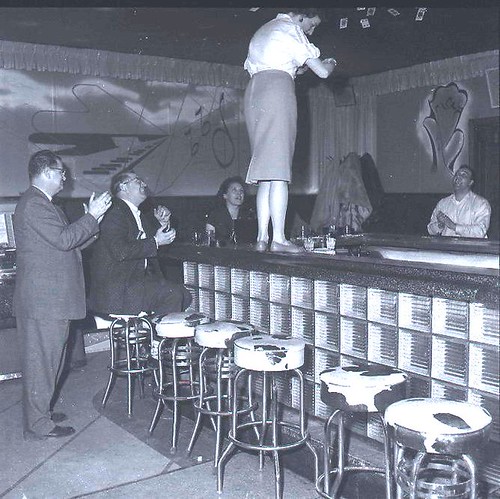
Photo: Louis Lanzano  via Wikimedia Commons
As the government shutdown continues,both sides of the political spectrum are bombarding us with their “messages” and agendas on each and every social media platform.  Where is the outrage or the impassioned support?  Where are the mass rallies and protests?  
Granted, there have been posts and comments across the social media landscape favoring both sides of the issue; but where are the living breathing bodies taking it to the streets?  Having lived in both the pre and current Internet worlds, I'm not expecting to see reactions on par with the Civil Rights marches, the Vietnam protests, or even burning of bras. I am disappointed at what I haven’t seen.  There have been those who have tried to bring focus to this hot-button issue.  Unfortunately, they do not seem to have the same outpouring of support as the release of the latest movie trailer or preview of this week's episode of a popular reality show.
One theory, and trust me it is just a theory not based on facts and figures, is that a majority of those utilizing social media have not grasped how this affects them directly. I know it is simplistic; but, for whatever reason, society tends to focus on the issues perceived to either benefit or harm us on a personal level. Everything about the events over the last week affects every single one of us.  Too many seem to be going about their daily lives with either blinders on or the belief that their opinions do not matter in the grand scheme of things.
An extremely simplistic example would be to ask a random sampling their thoughts on yesterday’s baseball scores, how their favorite golfer did, or what did they think of the photo of Sally dancing on the table. Compare this sampling to their thoughts on the political juggernaut in Washington. I fear that Sally’s dancing photo would probably get more comments, likes and shares.
Many believe that politics has no place in social media. Tell that to the media establishment that has latched on to social media with gusto.  News reports and political analyses are posted on the Internet for a reason. Not only to build up viewership, but as an open invitation for commentary and discourse.  Even more significant is that the political parties have become more social media savvy.  They understand that our voices are necessary to both formulate a successful platform and disseminate it.  When we are silent, we do both them and ourselves a huge disservice.
As you scroll through your daily news feed and notifications; take a moment between the animal photos, the birthday wishes, status updates and the event invites.  Click on a post you normally would have ignored.  Don’t be afraid to post a comment on how you feel. Share the post with your friends and connections in your social media network. Engage them in conversation.  There will definitely be differences of opinion; that is to be expected and encouraged.  It will open up the possibility of learning that there may be a point of view that you never considered before.  While you do not have to agree with the differing opinions; you will having a clearer understanding of it.
Be more vocal when reading something you either agree or disagree with.  Find a way to take your thoughts and ideas back to streets; away from the computer and smartphone with their perceived sense of anonymity. If you are not comfortable with marching down Main Street carrying a sign and chanting, so be it.  It will take baby steps. For a difference to be made and for change to occur, there needs to be dialogue. Get the conversation going in both the real and virtual worlds.

Extra! Extra! Have you read all about it?

The lede, the lead in, the teaser - whatever your preferred terminology; it's the string of words announcing the news article just posted/published by your media outlet of choice. Its sole purpose is to entice the reader or viewer to sit up and take notice.  It's meant to make you want to pick up the newspaper and read the details.  It prevents you from changing the channel during the commercial break so you can find out what happened.  Has this journalistic tradition been lost on  the “I want it now” generation?
In my opinion, one of the best innovations brought on by the Internet and social media has been the ability for the average consumer of news to post their commentary online.  It has moved the discussion of news events beyond the water cooler.  It has opened up the possibility of having frank and open discussions with people of varying opinions on a global scale. Media outlets will even post a quote or significant passage from the article preceding the link. However, this may have only perpetuated a growing problem. Those on the never ending quest for immediate gratification mistakenly believe they have full knowledge of the subject matter and are ready to move on to the next item or, worse yet, post their comments online.

Imagine a typical morning.  You are scrolling through your news feed and an article peaks your interest.  You open the link, read the full text and proceed back to the original social media site to the comments section. Before you enter your comments, you scan through the previous commentary.  How many times have you noticed that the previous commentators obviously did not bother to read beyond the headline and the introductory paragraph?  It has become more than a passing thing of late.   
Not only does it make the previous poster(s) look foolish but it turns those of us who did read the entire article into the Internet police.  We find ourselves spending more time correcting their misinterpretation of the facts in the article than being able to offer our own opinions on the piece in question.  More often than not it becomes a war of words rather than a peaceful discourse of ideas and opinion.

There is nothing wrong with people having differing opinions and being able to discuss them in a rational and educated manner.  That is not the purpose of this post.  I always look forward to a lively debate.  However, I expect my opponent to have read the full context of the article beforehand.  How they interpret what they read is subjective; but at least I will know we are starting on an even playing field.

Thursday, September 26, 2013

God's Presence on Social Media

While enjoying the morning’s first cup of coffee, I find myself scrolling through the notifications on the various social media sites to catch up with family and friends.  It never fails; there is always at least one request for prayers.  Having been raised in a strict Roman Catholic household, I understand and respect the power of prayer and one’s faith.  
On an emotional and spiritual level, I have great respect for a majority of the requests then come across my newsfeeds.  Requesting prayers when a loved  one is battling a life threatening illness or, worse, is one thing. I can personally get behind and support those requests.
The requests I have a tough time supporting are the ones such as these which gone way beyond the spiritual realm:
  • Please pray that my boyfriend doesn’t see this picture of me dancing on the bar last night after I told him I was too sick to go out.  
  • My car needs a new transmission, please pray that it doesn’t cost an arm and a leg.  
  • Matilda really has her heart set on attending Harvard, please pray that they look beyond her 1150 SAT score.  
  • Herman is interviewing for a promotion at work, please pray that he doesn’t screw it up like last time.
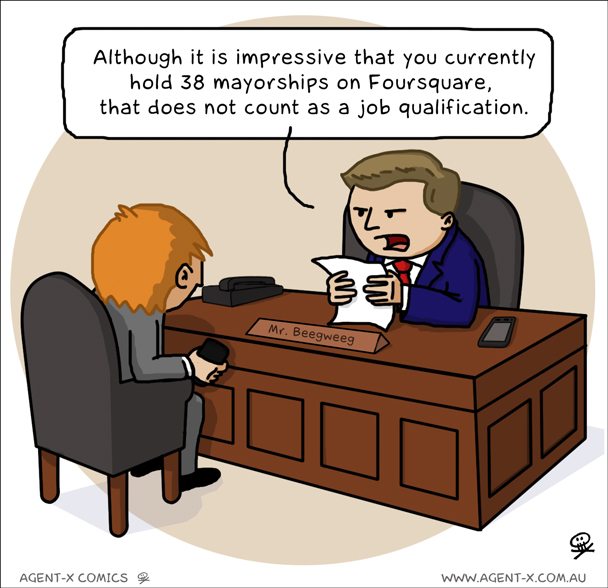
    Photo Credit: Agent-X Comics. www.agent-x.com.au
Are we to assume that God subscribes to Facebook, Google +, and Twitter?  Does he hold weekly hangouts?  Will he accept our friend requests?  If we don’t like and share the request, are we destined to go to hell?  Finally, if God has a Facebook timeline, how far back does it go and will we be able to finally answer the question of what he did on his day of rest?

Monday, September 23, 2013

The Day I Broke My Own Cardinal Rule

Well, now I have done it. My last post, Have You Hugged A Social Media Manager Today?; while an attempt to bring attention to those who give freely of their time and talents to provide nonprofit organizations and causes a social media presence, may have come across as what many would call a "cry for attention."  For that, I offer my sincere apologies.

One of my personal rules when it comes to social media has been to always try to put a positive spin on my posts. To try not to project negative personal feelings into what I write.  Feeling overwhelmed at the moment, I clearly broke that rule when I hit the publish button on Saturday.  In doing so, I not only failed myself; but you, as well.

Oh, sure, I could have easily removed the post and go on as if I never wrote it. All that would have accomplished, though, would have been a short lived sense of relief.  By leaving it up on the blog, it will serve as a reminder to me, and everyone else, that every article, post, tweet is not perfect.  There will be always be that one which will bring about either public or, in this case, personal backlash.  There will be those that appear self serving and more of a nuisance to your followers than anything else.

Social media management is no different than any other aspect of our lives.  We make mistakes. Rather than being viewed as the end of the world, mistakes should be viewed as learning experiences.  Reminders that we can always do better.

While I cannot guarantee that each and every post I make across all the social media platforms will be perfect, I will think twice before hitting the publish or submit button.  Should I slip up again, I ask that you please let me know.  If we are not made aware of our mistakes, we are unable to learn from them.

Saturday, September 21, 2013

Have you hugged a social media manager today?

"A social media manager is the individual in an organization trusted with monitoring, contributing to, filtering, measuring and otherwise guiding the social media presence of a brand, product, individual or corporation. Social media managers are often found in the marketing and public relations departments of large organizations." (source: WhatIs.com)

Many social media managers are also found in Internet cafes, co-working spaces, and, even at their kitchen tables.  These are the managers who take on this role as volunteers for organizations they belong to or for causes they hold near and dear to their hearts. Juggling the responsibilities of their personal lives, their real life jobs and the marketing tasks they agreed to do for little or no monetary compensation is no easy feat.  

While they may enjoy what they do for these organizations and causes; a hug, pat on the back or a simple acknowledgment of a job well done goes a long way. Don't make the assumption that because they enjoy being immersed in social media, they are willing to take on every task thrown at them.  As with any volunteer, there is the possibility of burnout; especially when they are not acknowledged for the work they do.

So the next time your organization meets, acknowledge those who volunteer what should be their "me time" to promoting your events and good news.  Giving them a hug, a pat on the back or, even, a cup of coffee can go a long way.


Friday, September 13, 2013

Social Media's Effect on Breaking News

In the not so distant past, families would gather in anticipation of hearing the familiar and soothing voices of David Brinkley, Walter Cronkite or Dan Rather. (Okay, so I grew up in a CBS household – more from the angle of the roof antenna than from choice.  For those of you with better reception or just simply a little bit younger than I; imagine Peter Jennings and Tom Brokaw.)  We knew if they had bad news to tell us, everything would be okay just because of who they were and how they presented it.  When the news was good, you found yourself sharing in their excitement from your living room.
Fast forward to the infancy of cable and the 24-hour cable news networks. How long did it take for us to realize that it was not in fact 24 hours of breaking news?  Was it after the third or fifth time the same news story was replayed on our television screens?
Social media has changed how we process news and information.  At any point in a 24 hour day, we log in and quench our thirst for news moments after it occurs or even as it is happening through live streaming.  With the influx of blogs, twitter and social media sites, we take on the role of “news distributors”.  (I use the term “news distributor” in deference to the professional journalist who is compensated to report the facts in an unbiased manner.)
We receive updates on our news feeds and share them with our network of friends. We post our commentaries and reactions before the facts have been fully fleshed out by seasoned journalists.  
Rallies are organized; independent investigative task forces are called for; and online petitions are started; all before the morning paper’s ink has had a chance to dry. The online distraction can become so intense that the full facts, when finally released, never seem to satisfy us. Social media has taken on the role of the fatherly news anchor types of the past.
We more driven by our initial reactions than ever before.  Gone are the days where facts and figures are left to the journalists to decipher and analyze for us.  We already know the lead story before the 11 o'clock news or the delivery of the the morning newspaper.  
As broadcast and print media continue to evolve in the Internet age, consumers of the news need to be flexible in how they react.  The days of the final edition are over. There will always be an update to an update.  Our indignation and disgust on Monday may be tempered by additional information in an update released on Wednesday.  

Saturday, September 7, 2013

When Blogging Morphs Into A Full Blown Infomercial

A blog (a contraction of the words web log)[1] is a discussion or informational site published on the World Wide Web and consisting of discrete entries ("posts") typically displayed in reverse chronological order (the most recent post appears first). (source: Wikipedia) 

Over the course of a day, I read blog posts written by various authors; many of whom have become giants in their respective industries. While not, by any means, denigrating their thoughts and ideas, I do have a problem with those authors who have turned their informative posts into infomercials.

Some authors have become so brazen as to have an embedded link to their website in every other sentence or paragraph.  Now, there is definitely nothing wrong with self promotion; however, the hard sell approach can become grating on the nerves; and to be perfectly honest, downright annoying.

Blogging is essentially online marketing of a brand, community or yourself.  It is, for all intensive purposes, no different than marketing offline.  You need to instill confidence in your followers (and potential clients) and open the lines of communication.  Past years of sales, marketing and customer relations taught me one thing, the soft sell approach has an overall greater effect than the hard sell.  

While your readers may have strong positive or negative opinions concerning your post, the overabundance of links to your sales site can be viewed as an obstacle to a productive dialogue.  More often than not, I stop myself from commenting or sharing someone's post for fear of appearing to be their salesperson; all because of the hard sell approach their article took.  

If you truly believe and stand behind your product, brand or idea and articulate this passion in a way that interests the reader, more often than not they will click through on the ONE link to your website at the end of the post or in the about the author box.  Taking on a more informative and conversational approach rather than a "used car salesman" approach opens your work up to more sharing and discussion.  Sharing and discussion is what it should be all about. If done correctly, making a sale is simply an added benefit.